Wednesday, April 4, 2012

More About Easter Week

Wednesday is the only day of Easter week that is not reported on by the gospel writers. But there are a few other things I’d like to point out today. First of all, in all the four Gospels (Matthew, Mark, Luke and John), one-sixth of the text is used to describe the twenty-four hours beginning with the last supper and ending with the burial of Jesus. This means that if every day in the life of Jesus were this complete we would have 180 volumes as large as our whole Bible (Vincent 1:433). Oh, how Matthew, Mark, Luke and John wanted us to understand the significance of the Atonement of Jesus Christ.

There are also many things I left out that happened on Tuesday. One I can’t neglect and that is the story of the Widow’s mite. We are told that Jesus was in the treasury which was a hall in the temple where gifts were deposited in thirteen receptacles shaped like trumpets. Jesus watched as one by one rich men paraded through the hall and cast their gifts into the trumpets, but then a poor widow cast in two meager mites. Not wanting this to go unnoticed by his disciples, Jesus made a point of it. “Of a truth,” He told them, “This poor widow has cast in more than all of the others. For they gave a little from their abundance, but she has given all she has.”

In contrast to this story we find another account concerning money. It was also on Tuesday that Judas set into motion the plot to kill Jesus. There is much irony in the very name Judas, for it means “he shall be praised.” We are told that Judas had become offended because of the Savior’s words (JST Mark 14:10) and so he went to the chief priests and asked, “What will ye give me if I deliver Jesus unto you?” And they agreed on a price of 30 pieces of silver.

Scholars and others have purported many estimates of what those 30 pieces of silver are worth in today’s money. I’ve found reports of anywhere between $7.20 to $40,000. This tells us that no one really knows for sure, but the fact that the chief priests later use the money to buy a plot of ground to be used as a cemetery tells us that it was a substantial amount of money. What is more important is that the 30 pieces of silver is fulfillment of a prophecy made in Zechariah 11:12 in which we are told, “So they weighed for my price thirty pieces of silver,” which in those days was the price that under the law of Moses a man must pay to a neighbor if the man’s animal caused the death of the neighbor’s slave. In other words, 30 pieces of silver was considered the monetary worth to replace a slave.
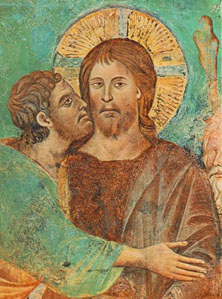
The symbolism of this slave metaphor is profound and in many Bible stories this symbolism foreshadows the “selling” of Jesus. For example, it was Judah, one of the twelve sons of Jacob, who proposed and sold his brother Joseph as a slave, and now it is Judas who proposes and sells his brother Jesus for the price of a slave.

After the crucifixion, Judas regrets what he has done and returns the money to the chief priests saying, “I have sinned in that I have betrayed the innocent blood” (Matthew 27:4). But the chief priests refuse (you can almost hear them laughing in derision) to accept the money for the temple treasury because it is “blood money” and would profane and desecrate the temple. The irony here is mind boggling. They are too pious to accept “tainted ” money, but have no qualms about murdering Jesus.

When they refuse the money, Judas throws down the silver, leaves the temple, and hangs himself. So the chief priests are left with the money and since they won’t put blood money in the treasury, they buy the potter’s field. Of this part of the story Zechariah prophesies, “Cast it unto the potter: a goodly price that I was prised at of them” (Zechariah 11:13).

Pondering these stories leads all of us to the question,
“What is Jesus worth to us?”
Discovering the answer to that question is what Easter week is all about.


Tuesday, April 3, 2012

The Savior's Teachings on His Last Tuesday


Tuesday of that last week began as Monday had with Jesus and his followers passing by the fig tree. Peter, seeing the withered tree, said to Jesus, “Master, behold, the fig tree which thou cursedst is withered away.”

And Jesus responded, “Have faith in God.” And went on to explain that with faith whatsoever they prayed for would be given, but that when they prayed they should forgive others.

Upon reaching the temple, Jesus’ authority was challenged by the chief priests and elders, but Jesus sidestepped went on teaching the people in parables. As he told them of the wicked husbandmen who killed the master’s son in order to take over the vineyard, you would think the priests would have recognized themselves, but they are too busy plotting and thinking up questions that they think will make Him look bad. One of them asks, if they should pay tribute to Caesar. In response he asks them to show him a coin. They produce a penny and he says, “Whose image is this?” 

“Caesar’s.” 

“Render therefore unto Caesar the things which be Caesar’s, and unto God the things which be God’s” (Luke 20:25). 

The Sadducees and Pharisees continue to ply him with questions, each hoping that Jesus will say something to incite the Romans, or to give them cause to arrest Him. The Sadducees, who don’t believe in an afterlife, ask about marriage in the next life. And a lawyer asks the famous question, “Which is the great commandment in the law?” Undaunted, Jesus turns this into a teaching moment instructing them to love God and to love one another. 

In this way He continues teaching with parables but then laments over the fate of Jesusalem. Drawing on the familiar words of the Hallel once more, Jesus finally testifies of his own death but instead of repenting they argue with Him even about that. His response is simply, “I came not to judge the world, but to save the world.” (John 12:47).

Sorrow can’t help but fill one’s heart as we read these accounts knowing that Jesus Christ is offering them the greatest gift ever offered to mankind and yet their pride and selfishness blind them so that they reject Eternal Life in exchange for satisfying their vanity.

At this point Jesus leaves, but his disciples follow him and ask several questions concerning the temple. This speech is found in Matthew 24, Mark 13, and Luke 21, and is called the Olivet Discourse or by some the Little Apocalypse. He explains that there will be false Messiahs and that destruction awaits Jerusalem and warns them to beware and to watch themselves at all times. He then goes on to teach them the parables of the ten virgins and the talents and finishes by telling them that He will judge the world. And what will be the criteria? As always His instruction is simple and easy to understand: “Inasmuch as ye have done it unto one of the least of these my brethren, ye have done it unto me.”

This brief retelling doesn’t begin to capture the depth and breadth of Jesus’ final teachings to the people on that Tuesday before His death. He knows what is coming and in love makes His last pleas for the people to repent and follow Him. But blinded by their sin the majority of the people refuse. Thus the irony begins to unfold; He will suffer and die to redeem the very sin they are at that moment committing and all other sin.

Monday, April 2, 2012

The Monday Before the Resurrection

On the last Monday morning of the Savior’s life, He and His disciples were on their way to Jerusalem when the Savior saw a fig tree along the path. Under the law of Moses trees growing “in the way” were common property and anyone could freely partake of the fruit. In addition this fig tree was full of leaves and fig trees normally produce fruit before leaves. Being hungry, the sight of a fig tree with leaves meant food, but when Jesus approached the tree He discovered it had no fruit and said, “Let no fruit grow on thee henceforward for ever” (Matthew 21:19) and the fig tree withered away.
For many this story is difficult to understand. Why would the Savior curse the tree just because it had no fruit? There are several answers. First, the fig tree that has leaves but no fruit is a symbol of hypocrisy just as people who create a self-image of righteousness but produce no righteous “fruits” are hypocrites. Thus by cursing the tree Jesus warns of the fate that awaits the impenitent and the hypocrites. Second, it was a witness to all who beheld the miracle that Jesus had power over death. They had seen him give life by raising Lazarus from the dead, but now they saw that He also had the power to administer death. The fact that He demonstrates this on a tree and not a person is testimony of His great love. The lesson had to be taught, but He teaches it in the kindest way possible. Third, it teaches those who had eyes to see about faith. On the morrow He will instruct his followers about faith and this experience will help them understand. It is also a foreboding of what is about to occur.

After cursing the fig tree, Jesus moves on to the temple and as He approaches discovers that it is polluted with moneychangers and animal vendors. Imagine the scene. Thousands of people have come from far away to celebrate Passover and to perform the rituals that are part of Passover. In order to do that, they need to offer animal sacrifices in the temple, but traveling with animals is cumbersome so they come intending to buy their sacrificial offerings when they arrive. To accommodate them enterprising vendors have set up their stalls not just as close to the temple entrances as they can, but in the temple compound. Men are shouting for people to buy from them, and their competitors are shouting louder and longer to get attention for their wares. Animals are bleating, bellowing, and cawing. Animal waste is filling the air with noxious smells, and all around is the chaos and confusion of an outdoor market in the height of tourist season. But wait, there is more! The temple would not accept Roman coinage because Roman coins were profane. Thus eager moneychangers are on hand to change Roman coins for the “holy” temple coins, and of course they add to the ruckus in an attempt to attract customers so that they can also make a nice profit. In short, the sounds, sights, smells and feel at the temple that day was anything but reverent and holy.

The interesting thing about this story is that Matthew, Mark, and Luke all record how Jesus chases away the vendors, but not one of them depicts Jesus as angry. The anger is something we readers assume. But think about it. There are probably scores of vendors and moneychangers at the temple and yet not one of them fights back. If He attacked them with anger it would normally incite anger in them. But instead they seem to leave without a fight. Could it be that because He of the premeditated, composed way He disperses them their own hearts are inflicted with guilt and they leave?

During the first year of Jesus’ ministry He cleansed the temple and at that time declared to the people, “Make not my Father’s house an house of merchandise” (John 2:16). This time, at the end of His ministry, He calls the temple His house saying, “My house shall be called the house of prayer” (Matthew 21:13). But the next day, Jesus will condemn the people for their wickedness and because of that relinquish the temple with the words, “Behold, your house is left unto you desolate” (Matthew 23:38). This is fulfillment of Jeremiah’s prophecy, “But if ye will not hear these words, I swear by myself, said the Lord that this house shall become a desolation" (Jeremiah 22:5).

About forty years from the time Jesus proclaimed that the temple had been polluted and was no longer His house, the Roman general Titus invaded Jerusalem and destroyed the temple so completely that there was not one stone left. This is amazing when one considers that some single stones of the temple were about 67 feet long and 7 feet high and 9 feet wide. The pillars supporting the porches were 37½ feet high. But a temple from which the people have evicted God, cannot stand.

That Monday, those many years ago, was memorable. By refusing to believe in and bear the fruits of righteousness, the beloved temple, like the fig tree, was destroyed.


Sunday, April 1, 2012

Sabbath Scripture - From the Hallel (Psalms 113-118)

O Give thanks unto the Lord;
for he is good;
because his mercy endureth for ever.
(Psalm 118:1)

The Lord is on my side;
I will not fear:
what can man do unto me?
 (Psalm 118:6)

Saturday, March 31, 2012

The Savior's Triumphal Entry (Palm Sunday)

On the last Sunday of the Savior’s mortal life the disciples brought to Him the donkey they had obediently obtained. As we talked about yesterday, the riding of a donkey was symbolic of the fact that He was King, but instead of a fine saddle of leather, gold and jewels that the king of the land would have had, this donkey was outfitted in humble cloaks from off the backs of the disciples—a gesture of love on their part.

This being the beginning of Passover week, Jerusalem was crowded with local Jews and thousands who had traveled from lands far away in order to celebrate Passover at the temple. Word that Jesus, the man who had raised Lazarus from the tomb, had come to Jerusalem spread quickly among them and curiosity impelled a great multitude to gather to see for themselves. Therefore, as Jesus rode down the Mount of Olives, crossed the wadi Kidron, and then began the assent to the Temple Mount, people thronged the streets to greet Him. Overcome with emotion many took off their cloaks and laid them on the ground to make a path for Him. Others cut palm branches, a symbol of victory, and waved them as He passed. And those that followed Him and those He approached all began to cry out saying, “Hosanna to the Son of David: Blessed is he that cometh in the name of the Lord; Hosanna in the highest” (Matthew 21:9). Hosanna means “save now,” and these words are part of the Hallel which was used in the temple during sacrificial rituals to help the people remember that the animal sacrifices they were offering were a semblance of The Sacrifice that would occur when a Messiah atoned for the sins of mankind.

The Hallel consists of Psalms 113-118, which are recited not only during sacrificial rituals but on many other joyous occasions. The Hallel was traditionally recited as part of morning prayer services, and during the first night of Passover was part of evening prayers. Reading these six Psalms will help you feel the meaning of Easter, but there is one verse that is particularly poignant to me and illustrates the irony of what is occurring. Sunday the crowd praises Jesus and through word and actions proclaims Him their king, but on Friday they will cry out, “We have no king but Ceasar” (John 19:15). And in the Hallel we read, “The stone which the builders refused is become the head stone of the corner” (Psalm 118:22).

As the crowd shouts “Hosanna!” the Pharisees call on Jesus to rebuke the disciples for such blasphemy. But Jesus answers them, “If these should hold their peace, the stones would immediately cry out!”

As the procession slowly drew near to the city, Jesus wept, and said, “If thou hadst known, even thou, at least in this thy day, the things which belong unto thy peace! But now they are hid from thine eyes” (Luke 19:42). There is much debate over the meaning of the word Jerusalem, but some have said it means “Founded peaceful.” If that is the case, the Savior’s sorrow is even more meaningful. The city was intended as a place of peace and refuge for the House of Israel, but men had turned it into a place of iniquity. Thus great destruction, pain, and suffering await the inhabitants and Jesus prophecies of that impending doom while weeping. (Luke 19:42-44).

But the message is for all of us. God will save us from destruction. Even the stones of the earth know that. And the Savior was given us to “found us peaceful” in the midst of this world of chaos and iniquity. This is the promise that is ours—this “belongs to our peace” if we will lay down our cloaks on the path of righteousness and follow the Savior crying, “Hosanna to the Son of David: Blessed is he that came in the name of the Lord.”

Friday, March 30, 2012

Preparation For The Triumphal Entry

Jesus arrived in Judea before Passover week began and supped in Bethany with His friends. Word spread quickly that He was in the area and large groups of people began to assemble. John tells us that they came not only because of Jesus but to see Lazarus, the man who had been dead and buried but raised from the tomb. Despite whether they came to see Lazarus or Jesus, once they had seen Jesus many went away believing in Him, and marveling at the things He had done. This irritated the Chief Priests so much they counseled together how they might put both Jesus and Lazarus to death and put a end to all this talk of miracles and messiahs.

As the Chief Priests went about their devious plotting, Jesus walked over the mountain into Bethphage and the Mount of Olives, and from there he sent two disciples into the nearby village to bring back an ass that no one had ever sat upon. He told them that as soon as they entered the village they would see the colt tied by a door. Jesus  warned them that as they loosed the colt, they would be asked, “Why do ye this?” and they were to simply answer, “The Lord hath need of him.” Upon hearing this, the men would readily agree to send the colt with them.

The disciples did as Jesus commanded and everything happened exactly as He told them it would.

The interesting thing about this account is that Jesus knew exactly where the colt would be found and even the words that would be spoken. Looking back on this experience after the crucifixion, the disciples could not help but understand that this was part of the plan that would bring about His death. He knew, when He asked them to go for the colt, what lay ahead for Him.

But there is more to learn from this account. An ass had specific symbolism that is important here. Horses were used by soldiers for warfare, but an ass or a mule were gentler animals and thus symbols of royalty. While history often shows us kings who are selfish and proud, the intent has always been that a king should be someone who loves, protects, and cares for his people. Thus by His choice to ride an ass, Jesus proclaims to all who have eyes to see that He has come not as a warrior who will save them from Roman bondage, but as a King who will save them from the bondage of sin. And just as the colt had never been ridden before, this type of King had never been known before.


Thursday, March 29, 2012

Just Before Passover


If we had as much written about every week of the Savior's life as we do about the last week, we’d fill the Library of Congress with just those books. We'll beginning detailing that week soon, but there are a few things that happened just prior to His last week that get our minds and hearts ready for what is to come.

Six days before Passover, on the day before the Triumphal entry, Jesus arrived in Bethany at the home of the siblings Mary, Martha, and Lazarus. He often stayed with them and his great love for them was made evident when He raised Lazarus from the dead probably a couple months before this time. (See John 11:43.) When He arrived a supper was made for him, and as we know, Martha was chief caretaker at that event. It is easy to imagine her bustling around making sure everyone is comfortable and has enough to eat. She must have been the consummate hostess. But while Martha showed her love for the Savior by taking care of His physical needs, Mary expressed her love by taking a pound of ointment of spikenard, which we are told was “very costly” and anointed Jesus’ feet. The word spikenard in Hebrew is nard and means “light.” In Greek the word for spikenard means “pure and genuine.”

The amount of ointment is amazing. Think of the size of a pound of butter. No wonder John tells us that the house was filled with the beautiful scent of the ointment. In a day when the stink of unwashed bodies, rotting food, waste, and debris constantly accosted people, the fact that this sweet scent of spikenard filled the air must have been unforgettable. But instead of enjoying the aroma Judas Iscariot, was displeased. “Why was not this ointment sold for three hundred pence, and given to the poor?” (John 8:5), he asked. A pence was a day’s wages for the common working man, which makes Judas’ concern understandable if one is only looking at the materiality of the event. 

But in John the Savior responds, “Let her alone; against the day of my burying hath she kept this. For the poor always ye have with you; but me ye have not always” (John 12:7-8). And Mark reports that he says,“For verily she has come beforehand to anoint my body to the burying. She has done what she could: and this which she has done unto me shall be had in remembrance in generations to come, wheresoever my gospel shall be preached; Verily I say unto you, Wheresoever this gospel shall be preached throughout the whole world, what she hath done shall be spoken of also for a memorial of her” (JST Mark 14:8-9).

The Savior’s words indicate that Mary knew what was coming. She knows He is going to die and is anointing Him in preparation for that death, but besides the anointing we are told that Mary wiped his feet with her hair.  The reverence, the awe, the love of that gesture sink deep into my heart. This is an event filled with significant symbolic meaning. In great reverence she anoints the Light of Life with spikenard (a symbol of light) and wipes the ointment onto His feet with her hair (anciently a symbol of life). In doing so, she is symbolically proclaiming that He will die, but His death will give light and life to us.