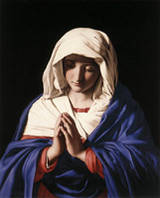
Showing posts with label Mary. Show all posts

Monday, December 24, 2012

Mary the Mother of Jesus


I’ve always felt our Christmas celebrations pay too little attention to the mother, Mary. She played a magnificent role in the coming forth of the Son of Holiness and my own celebrating and worshiping is enhanced when I think of her. Two of my most meaningful Christmases were the ones when I gave birth to a baby in December. I remember wrapping my babies and thinking of Mary swaddling hers and imagining what she did and thought.

Most scholars believe she was young, perhaps fourteen or fifteen years old, because it was the custom of the day to betroth a daughter when she began to menstruate. Other scholars argue that in New Testament times menstruation happened later, but even sixteen or seventeen is young.

Some have interpreted the verse, “But Mary kept all these things, and pondered them in her heart” (Luke 2:19), to mean that Mary was bewildered and didn’t know what was going on. To me that is absurd. All of Mary’s life people had talked about the prophesied Messiah. She couldn’t have been unaware of the teachings and longing for a Messiah. But more than that, an angel appeared to tell her that she was going to bear the child, and then she found herself with child when she had never known a man. How could she not have known?

Of all people, Mary was the one who knew—not just believed but knew—that the Savior of the world had come and that He was indeed God's son. She knew the baby she had suffered so much pain to bring into the world was the long awaited Messiah. To me the fact that she kept the things in her heart indicates that she knew how sacred the events and happenings were and therefore she didn’t speak openly about them. Instead she kept the details to herself and pondered on them often.

Of all the women in the world, Mary was the one worthy and willing and ready to mother the Son of God. We are told she was a virgin. The word originally meant simply a young woman.

But the definitions now include, “an unmarried woman devoted to religion,” “a woman who has not had sexual intercourse,” and “a person who is inexperienced in a usually specified sphere of activity.” Mary fits all the definitions. The birth we celebrate was to a virgin who had never known a man, a virgin innocent and pure.

Perhaps that is the most important symbol of the Christmas season, for it is only in a pure and innocent heart that Christ can be born again.

Saturday, April 7, 2012

The Crucifixion and Last Words of Jesus

Crucifixion was designed to cause death but to do so at the slowest, most torturous pace. The agony was intense as wounds tore and bled, and muscles and joints pulled from tendons and sockets. But that is not what caused death. The strain of hanging by the arms eventually caused asphyxiation as the person lost the ability to breathe.


That day on Calvary two others were executed alongside Jesus. One of them joined the Jewish leaders in deriding Jesus and cried out, “If thou be Christ, save thyself and us” (Luke 23:39). But the other rebuked the first saying, “Dost not thou fear God. . . .We receive the due reward of our deeds: but this man hath done nothing amiss.”

Then to Jesus he said, “Remember me when thou comest into thy kingdom.”

Many of the women who had followed Jesus were sorrowing at the cross including Jesus’ mother. When Jesus saw her there he said,, “Woman, behold thy son!” Then to John he said, “Behold thy mother!”

At noon darkness fell over the land, and for the next three hours the sun was hid. Finally after three hours of suffering, Jesus cried out, “My God, my God, why hast thou forsaken me?”

John tells us that then, knowing all things were now accomplished, Jesus said, “I thirst.”

In response someone dipped a sponge into a pot of vinegar, put the sponge on a hyssop reed, which would have been about three or four feet long, and lifted it to Jesus’ mouth. After He had sucked from it Jesus said, “It is finished. Father, into thy hands I commend my spirit” (Luke 23:46). Then bowing his head, as the Greek text says, Jesus breathed out his last breath and delivered up His spirit.

Meanwhile at the temple the new course of Levites were performing the sacrificial rituals and at this same moment the trumpets announced that the ritual service was one-third over. Inside the Holy Place the veil separating it from the Most Holy Place ripped in two. The symbolism of this incident is beautiful. Before only the High Priest, representing Jehovah, could enter the Most Holy Place which contained the throne of God, and he was only allowed in once a year on the day of Atonement. With the veil rent, the way back to God was now open for all mankind. But there is something more. Josephus tells us that according to the Rabbis, the veil was a handbreadth thick. It was woven of 72 twisted plaits, each consisting of 24 threads (24 ply yarn!). Josephus, who tends to exaggeration, also informs us that the veil was so large it required 300 priests to lift it into place. But at the moment of Christ’s death it miraculously ripped in two from top to bottom.

Wanting the ordeal to be over before the Sabbath began, the Jewish leaders implored Pilate to expedite the crucifixion. Under orders, then, the soldiers broke the legs of the two thieves so that they could no long push themselves up by the small platform at their feet and would suffocate. But when they came to Jesus, He was already dead. Seeing this one of the soldiers thrust his spear into the Savior’s side and blood and water gushed out. This is significant in that it indicates that instead of dying by asphyxiation, Jesus’ heart literally ruptured making the cause of death a broken heart.

After the death of Jesus, Joseph of Arimathaea asked Pilate for the body and he and Nicodemus lovingly anointed Jesus with myrrh and aloes, wrapped Him in linen burial clothes and spices, and placed him in a never before used sepulcher over which was rolled a stone.

On Saturday the Jewish leaders, remembering that Jesus had said that after three days He would rise again, asked Pilate to place a guard at the sepulcher for they feared someone would steal His body and then claim Jesus had risen. Pilate consented, saying, “Ye have a watch: go your way, make it as sure as ye can” (Matthew 27:65). Given permission, the Jewish leaders sealed the stone door and set soldiers to guard the tomb.

But soldiers would not be enough to secure this tomb.

Thursday, December 22, 2011

Celebrating Christmas--The Mother and Child


I’ve always felt our Christmas celebrations pay too little attention to the mother, Mary. She played a magnificent role in the coming forth of the Son of Holiness and my own celebrating and worshiping is enhanced when I think of her. Two of my most meaningful Christmases werethe ones when I had a baby in December. I remember wrapping my babies and thinking of Mary swaddling hers and imagining what she did and thought.

Most scholars believe she was young, perhaps fourteen or fifteen years old, because it was the custom of the day to betroth a daughter when she began to menstruate. Other scholars argue that menstruation happened later at that time, but even sixteen or seventeen is young.

Some have interpreted the verse, “But Mary kept all these things, and pondered them in her heart” (Luke 2:19), to mean that Mary was bewildered and didn’t know what was going on. To me that is absurd. All of Mary’s life people had talked about the prophesied Messiah. She couldn’t have been unaware of the teachings and longing for a Messiah. But more than that, an angel appeared to tell her that she was going to bear the child, and then she found herself with child when she had never known a man. How could she not have known?

Of all people, Mary was the one who knew—not just believed but knew—that the Savior of the world had come. She knew the baby she had suffered to bring into the world was the long awaited Messiah. To me the fact that she kept the things in her heart indicates that she knew how sacred the events and happenings were and therefore she didn’t speak openly about them. Instead she kept the details to herself and pondered on them often.

Of all the women in the world, Mary was the one worthy and willing and ready to mother the Son of God. We are told she was a virgin. The word originally meant simply a young woman.

But the definitions now include, “an unmarried woman devoted to religion,” “a woman who has not had sexual intercourse,” and “a person who is inexperienced in a usually specified sphere of activity.” Mary fits all the definitions. The birth we celebrate was to a virgin who had never known a man, a virgin innocent and pure.

Perhaps that is the most important symbol of the Christmas season, for it is only in a pure and innocent heart that Christ can be born again.

Friday, December 9, 2011

The Stable Cave

We all know that Jesus was born in a stable, but the facts about that stable, about how they got there and what it is, are not so well understood. The word the King James translators choose to translate as inn, kataluma, is the same word that Mark and Luke later use for the Upper Room in which the Last Supper is held.
In both Luke 22:11 and Mark 14:14 the same Greek word, katalum, is translated as guestchamber, and in the story of the Good Samaritan the word translated as inn is not kataluma, but pandeion.

What most scholars now believe is that Mary and Joseph went to stay with relatives in Bethlemem (which makes sense also because Bethlehem was such a small town it would be unlikely to have enough business to support an inn), but by the time they arrived their relatives' guestroom was already taken and so they stayed in the stable. This makes sense because many homes in that day were built in front of a cave and used the cave to stable animals and supplies.

But where the stable is isn’t the important thing. The stable is still a stable filled with animals and the filth and stink that go along with a stable. I can imagine how Joseph and the relatives worked to make the cave as comfortable as possible as Mary stove against the pains that would bring our Savior into the world.

Again the symbolism is astonishing. Caves are under ground. They are below the earth's surface and from this underground stable-cave Mary brought Jesus forth and gave Him mortal life. This foreshadows the event three decades later when, from an underground sepulcher-cave, Jesus would come forth to give Mary and all of us immortal life.

Both caves remind us that Jesus descended “below all things” (see 1 Nephi 11:16; D & C 88:6). Theologians call this the condescension of God, and Paul describes it like this: He was God “but made himself of no reputation, and took upon him the form of a servant, and was made in the likeness of men” (Phil. 2:7). The King James translators chose to translate the Greek word used in this verse as reputation, but a more accurate translation is that Jesus “emptied himself.” He was God, yet He emptied himself of power to begin anew, growing from grace to grace.

He is the Word, and yet He came as a wordless infant.

He is the Almighty One, and yet helplessly
He took nourishment at Mary’s breast.

He is King of kings,
and yet He came as the servant of man.

He, the great I Am, condescended
below all things
to be the beast upon which all burdens would fall.


Friday, December 24, 2010

Celebrating Christmas—The Virgin Birth

I’ve always felt that Christmas celebrations pay too little attention to the mother. 
Perhaps it is an over-reaction to some in the world who have gone
too far in attributing power to her.
However it has happened, 
she played a magnificent role in the coming forth of
the Son of Holiness 
and my own celebrating and worshiping is enhanced when I think of her.

Most scholars believe she was young, perhaps fourteen or fifteen years old. 
Some have taken the verse, 
“But Mary kept all these things, and pondered them in her heart” (Luke 2:19), 
to mean that Mary was bewildered and didn’t know what was going on. 
To me that is absurd—everyone around you has talked about the prophesied Messiah,
an angel appears to tell you that you are to bear the child, 
and then you have a baby without ever knowing a man, 
and you don’t know? Of all people, 
Mary was the one who knew not just believed..
Instead to me the verse indicates that the events and happenings were very sacred 
and so Mary kept the details to herself but pondered on them often.

Of all the women in the world, Mary was the one worthy and willing and ready
to mother the Son of God. 
We are told she was a virgin
The word originally meant a young woman. 
But the definitions now include, “an unmarried woman devoted to religion,” 
“a woman who has not had sexual intercourse” 
and “a person who is inexperienced in a usually specified sphere of activity.”  
 And Mary fits all the definitions. 
The birth we celebrate was to a virgin, innocent and pure. 

Perhaps that is the most important symbol of the season, 
for it is only in an innocent and  pure heart that 
Christ can be born again. 

Wednesday, June 2, 2010

Sometimes It's The Feeling That Teaches

Today in my New Testament class we began with an incident that happened just before the last week of the Savior's life when Mary anointed the Savior’s feet with costly spikenard. I have always loved this story and the fact that Mary anoints the Savior. She doesn’t just apply oil or spread salve—she anoints. One of the dictionary definitions of the word anoint is “to designate as if by a ritual anointment.”

The Savior goes on to chastise the disciples who have criticized her because they consider it a waste of valuable ointment. He says to them, “Let her alone: against the day of my burying hath she kept this.”

To me this means that the definition cited above is Mary’s motive. Through this anointing she is designating Jesus Christ the Messiah and specifically her Messiah. She has made an enormous sacrifice in using this costly spikenard on the Savior. By that she demonstrates her love and her righteousness. Kings and Priests were anointed in that day and she is anointing Him as her King and her Priest.

This also speaks to me of the value the Savior had for women. It isn’t Peter who anoints him—it is Mary. I often get the feeling when I read this that I do not understand all that is going on in this story. But at the same time, I get the feeling that someday I will understand and it is going to be a glorious insight.

Wednesday, December 23, 2009

Mary the Mother


At the end of the Nativity account found in Luke 2 we are told that “Mary kept all these things, and pondered them in her heart” (Luke 2:19). Some authors have taken this to mean that Mary didn’t understand what was going on. But I don’t believe that. To think Mary was naïve is to completely disregard the beautiful Psalm that Mary utters when she visits Elizabeth.
“My soul doth magnify the Lord, And my spirit hath rejoiced in God my Saviour. For he hath regarded the low estate of his handmaiden: for, behold, from henceforth all generations shall call me blessed.  For he that is mighty hath done to me great things; and holy is his name. And his mercy is on them that fear him from generation to generation. He hath shewed strength with his arm; he hath scattered the proud in the imagination of their hearts. He hath put down the mighty from their seats, and exalted them of low degree. He hath filled the hungry with good things; and the rich he hath sent empty away. He hath holpen his servant Israel, in remembrance of his mercy; As he spake to our fathers, to Abraham, and to his seed for ever” (Luke 1:46-55).

Even if you believe that these aren’t Mary’s own words and that someone later attributed them to her, you know that after what she had seen and experienced these kinds of thoughts couldn’t help but be part of her thinking. She had seen and experienced things that no mortal before her or after her has ever experienced. There is no way she could be naïve. The prophecies were talked about constantly and even if, as a woman, she was not part of the synagogue discussions, she could not help but overhear the men talking of the Messiah that would be born to a virgin. She would know what His mission was to be and how He would be sacrificed for the sins of the world. Mary knew all these things.

I can only imagine what it would mean to cradle my newborn son in my arms and know the horrific fate that awaited him. Every time she saw a sacrificial offering at the temple, or heard of one, her heart must surely have broken. Of all people, Mary knew who this baby was. That she kept all that happened and pondered it in her heart was not a sign of ignorance, but an indication of the burden she lived with. Her Son would die for her and for all of us.

Picture by Amy Pectol : http://amypectol.com/

Tuesday, December 8, 2009

Feeling Christmas


I can’t get enough of Christmas this year. I think it is because I missed Christmas last year. The brain surgery was on December 19th and the entire week before that I was going through testing and visiting doctors and scrambling to get people to take care of my three religion classes and at the end of a semester with all the work that entails doing that was a major endeavor. So, last year I didn’t experience much of Christmas let alone enjoy it.

But this year every light, every note of Christmas music, every Christmas movie, every Christmas wish is sinking into my heart and exploding in joy. It’s like I am experiencing Christmas for the first time! But it is much more than just the décor and music; those things are simply catalysts. I find myself this year really pondering Christmas. For example, yesterday I heard “Round yon virgin, mother and child” and I began to think of Mary and what Christmas meant to her.

I’ve had children. I know the pain and the emotions of childbirth. But Mary was young and alone. Most scholars think she was probably about fourteen years old. Certainly she was scorned by the small community of Nazareth for getting pregnant before being married. And then there was the journey, about 90 miles, to Bethlehem while being pregnant. Tradition tells us she rode a donkey, but walking would be more comfortable than the jolting ride on a donkey. I imagined how she felt, her first child and she was without mother or sister or female kin of any kind! Alone, rejected, inexperienced, far from home, in a dirty, stinky stable she gave birth to the Son of God. She wasn’t spared the pain, the emotions, the fear or any of the other things that accompany child birth, but she did it.

Not knowing how she would deliver, or who would help her, or what would happen to her, she went forward trusting that God would help her and care for her. Oh, the faith of that woman!

This Christmas I’m not just thinking about but feeling the birth of the Savior in all its wonder and glory, and I’m appreciating  those who helped bring Him into the world. I’m celebrating it all!