Sunday, December 11, 2011

Sabbath Scripture--Mary's Psalm

And Mary said:
My soul doth magnify the Lord,
And my spirit hath rejoiced in God my Saviour.
For he hath regarded the low estate of his handmaiden:
for, behold, from henceforth all generations
shall call me blessed.
For he that is mighty hath done to me great things;
and holy is his name.
And his mercy is on them that fear him
from generation to generation.
He hath shewed strength with his arm;
 he hath scattered the proud
in the imagination of their hearts.
He hath put down the mighty from their seats,
 and exalted them of low degree.
He hath filled the hungry with good things;
 and the rich he hath sent empty away.
He hath holpen his servant Israel,
 in remembrance of his mercy;
As he spake to our fathers,
to Abraham, and to his seed for ever.
Luke 1:46-55


Saturday, December 10, 2011

Christmas Angels


"Heavenly Hands" by Greg Olsen (click here)

There is one thread that weaves through the entire Nativity story—the angels. The English word angel comes from the Greek word angelos which means “messenger.” A messenger is someone who carries a message from one person to another and these messengers carried the Glad Tidings or Good News from God to man.


First the angel Gabriel delivered the message to Mary that she would be the mother of the long awaited child. Next Joseph received a visit from Gabriel and was told to “fear not to take unto thee Mary thy wife; for that which is conceived in her is of the Holy Ghost” (Matthew 1:20).

But when we think of angels at Christmas time, we usually think of the angel who appeared to the shepherds tending their sheep in fields near Bethlehem. He delivers his message, “Fear not; for, behold, I bring you good tidings of great joy, which shall be to all people. For unto you is born this day in the city of David a Savior, which is Christ the Lord. And this shall be a sign unto you; Ye shall find the babe wrapped in swaddling clothes, lying in a manger” (Luke 2:10-12).

As soon as he made the announcement the heavens opened—as if the joy was more than heaven could contain any longer—and suddenly a great multitude of angels burst forth in song.

For a moment imagine with me that you were one of those angels—a messenger. You knew that your Savior had been born. You knew that because of that birth the misery, depravity, abuse, and horrors of a mortal world now had a cure. The Light of the world had been born to put all things right and the joy of that knowledge filled you until like an erupting volcano the joy spewed forth. Imagine how you felt. This wasn’t just good news; this was the greatest news of all time. And you couldn’t contain the happiness you felt. As the heavens opened you sang, “Glory to God in the highest, and on earth peace, good will toward men” (Luke 2:14). 

What a choir that must have been—the sound of heaven rejoicing!

But you don’t have to imagine. The same thread that ties the Nativity story together, ties you to the story. You are the angel--the messenger! Christmas is the opportunity for you to sing, or pray, or shout your praises or in any way you can to convey the Good News to all those around you that a Savior has come to save the world. 


Friday, December 9, 2011

The Stable Cave

We all know that Jesus was born in a stable, but the facts about that stable, about how they got there and what it is, are not so well understood. The word the King James translators choose to translate as inn, kataluma, is the same word that Mark and Luke later use for the Upper Room in which the Last Supper is held.
In both Luke 22:11 and Mark 14:14 the same Greek word, katalum, is translated as guestchamber, and in the story of the Good Samaritan the word translated as inn is not kataluma, but pandeion.

What most scholars now believe is that Mary and Joseph went to stay with relatives in Bethlemem (which makes sense also because Bethlehem was such a small town it would be unlikely to have enough business to support an inn), but by the time they arrived their relatives' guestroom was already taken and so they stayed in the stable. This makes sense because many homes in that day were built in front of a cave and used the cave to stable animals and supplies.

But where the stable is isn’t the important thing. The stable is still a stable filled with animals and the filth and stink that go along with a stable. I can imagine how Joseph and the relatives worked to make the cave as comfortable as possible as Mary stove against the pains that would bring our Savior into the world.

Again the symbolism is astonishing. Caves are under ground. They are below the earth's surface and from this underground stable-cave Mary brought Jesus forth and gave Him mortal life. This foreshadows the event three decades later when, from an underground sepulcher-cave, Jesus would come forth to give Mary and all of us immortal life.

Both caves remind us that Jesus descended “below all things” (see 1 Nephi 11:16; D & C 88:6). Theologians call this the condescension of God, and Paul describes it like this: He was God “but made himself of no reputation, and took upon him the form of a servant, and was made in the likeness of men” (Phil. 2:7). The King James translators chose to translate the Greek word used in this verse as reputation, but a more accurate translation is that Jesus “emptied himself.” He was God, yet He emptied himself of power to begin anew, growing from grace to grace.

He is the Word, and yet He came as a wordless infant.

He is the Almighty One, and yet helplessly
He took nourishment at Mary’s breast.

He is King of kings,
and yet He came as the servant of man.

He, the great I Am, condescended
below all things
to be the beast upon which all burdens would fall.


Thursday, December 8, 2011

The Swaddling


During New Testament times babies, especially male babies, were considered a great blessing, the very “salt of the earth.” Therefore when a baby was born into a family it was washed with water, rubbed with finely pulverized salt, then rubbed with oil, and lastly swaddled. An illegitimate baby could not be salted or swaddled.

The swaddling was done by first placing the washed baby diagonally on a swaddle cloth. The infant was then rubbed with finely powdered salt and oil. The cloth was then brought up and over the baby’s arms, legs, and torso. Next the end of the swaddle band, made by tying together strips of linen cloth about four or five inches wide and up to six yards long, was held under the baby’s chin, then wrapped up over the forehead and then around and around the infant all the way down to the feet. Swaddling kept the child warm, restricted movement, and it was also thought that it ensured the baby would grow strong without deformity.

Because of this a swaddled baby is a metaphor for a legitimate child that is loved and properly cared for. Thus Ezekiel says when chastising Israel, “Thy birth and thy nativity is of the land of Canaan; thy father was an Amorite, and thy mother an Hittite. And as for thy nativity, in the day thou wast born thy navel was not cut, neither wast thou washed in water to supple thee: thou was not salted at all, nor swaddled at all” (Ezekiel 16:4). 

In other words, Israel is so wicked they have become illegitimate children. They have chosen to be children of the Hittites and the Amorites (children of the world) rather than be legitimate children of their Heavenly Father who would have swaddled and loved and cared for them.

 I love this small detail about Mary swaddling her baby because it tells us so much. First of all it gives us a glimpse into the heart of Mary who cared for her child in the best possible way. To us Jesus Christ is our Master, our Savior, our Protector, but for a time to Mary He was a dependent child. That is a relationship no one else will ever share with Him.

But there is something else. Of all people, Mary knew the significance of this child and the circumstances concerning His conception. She knew that despite the rumors and hatemongers this child was legitimate and so by swaddling Him she proclaims to the entire world that her baby is God’s legitimate Son.

One can only imagine what Mary thought as she wrapped Him. From the moment of the miraculous conception, if not before, Mary must have sought for any information about the fate of this child. There were many prophecies, and Mary must have hung on every word the rabbis and others said about the coming Messiah. She must have asked questions and in the answers would have discovered the terrible fate that awaited her little boy.

Therefore, did wrapping Him in swaddling clothes make her think about the fact that one day He would be wrapped in similar looking grave clothes? Did seeing him wrapped tightly in the bands of birth make her think of the bands of death that would surely come to Him? 

Whether she thought about any of these things or not, the bands Mary swaddled her Son in remind us of the day He was wrapped in burial linens and placed in a tomb. He was born to die for us, and by so doing He “swaddled” us, proclaiming us His legitimate children and providing a way to take away our “deformity.” But most important, Jesus Christ has changed our burial linens into the swaddling bands of new birth.

Wednesday, December 7, 2011

"Away in a Manger"


When I was a child my favorite Christmas carol was “Away in A Manger.” We sang a version in which the chorus divided into two parts and half of us would sing “asleep” and then the other half would echo “asleep” in lower tones. Then all together we’d sing, “Asleep the Lord of all.” I loved hearing the volley of voices, but I especially loved thinking about that new born baby in his straw bed, the animals looking on, his mother tenderly swaddling him.

Being a city girl, for me the word manger was synonymous with bed or cradle. No one ever explained to me that a manger is a box used to feed animals. In other words, it is a feeding tough. Our word manger comes from the French word manger which means “to eat.” In Bethlehem the manger in which Mary placed her Son would most probably have been carved out of stone.
stone manger

As I learned these facts about the manger my earlier imaginings began to grow. I now picture Joseph carefully cleaning out the feeding trough worrying about his young wife and the responsibility he had to protect her and the child. I see him gathering the best straw to make a soft nesting place for the baby. I wonder if Mary swaddled the baby herself or if someone was there to help her. According to the law of Moses it was unlawful for a man to witness child birth, but if no one else was available perhaps Joseph had to serve as midwife and nurse. Perhaps he first swaddled the baby and placed Him in the manger.

Whoever did it, I doubt that at the moment the significance of what they did registered with them. Here they were in the House of Bread placing The Bread of Life not in a cradle, but on a feeding trough, a symbolic offering that invites you and I to partake of the Eternal Bread.

I can’t think of that manger cradling the Bread of Life now without being reminded of the weekly feeding tough—the Sacrament table—I visit to partake of the Bread of Life. As I ponder on it, I can hear the words, "He that cometh to me shall never hunger" (John 6:35). "He that eatheth of this bread shall live for ever" (John 6:58), and I am remind that the Bethlehem manger offers Eternal sustenance to all mankind.


Tuesday, December 6, 2011

Celebrating Christmas - Bethlehem


"Journey to Bethlehm" by Joseph Brickey (click here)

The Nativity begins with the decree that the people of Palestine must participate in an enrollment or census to facilitate the assessing and collecting of taxes. For Joseph and his young bride that meant they must travel about ninety miles south to the town of Bethlehem which would have been at least a five day journey—especially for a pregnant woman. If they traveled the most likely route this meant they went through Jericho (the lowest point on the earth) and then up the hill country to Bethlehem, a hike of 3,500 feet. Having given birth to ten children, the thought of Mary making such a journey shortly before giving birth amazes me.
Bethlehem, years ago

But it was important that she go to Bethlehem. It was well known at the time of the Savior’s birth that the Messiah would be born in Bethlehem. When the wise men traveled to Jerusalem and inquired of Herod about the new king, Herod assembled his wise men and leaders and “demanded of them where Christ should be born. And they said unto him, In Bethlehem of Judaea: for thus it is written by the prophet, And thou Bethlehem, in the land of Juda, art not the least among the princes of Juda: for out of thee shall come a Governor, that shall rule my people Israel” (Matthew 2:4-6). 

But it is not just prophecy that makes the place significant. The word bethlehem means “house of bread.” I will never forget the amazing feelings that surged through me the first time it struck me that the Bread of Life was born in the House of Bread. Ever since then I can’t think about those words or hear the hymn “Oh Little Town of Bethlehem” without feeling the swelling warmth within me once again especially when I hear the last phrase of the hymn, “The dear Christ enters in.”
The Church of the Nativity in Bethlehem today

Physically the Bread of Life was born in the House of Bread. Spiritually the Bread of Life is born again in everyone who chooses to partake of Him.

Monday, December 5, 2011

The Date of the First Christmas


The exact day of Jesus’ birth is highly debated. If you search it out, you can find theories that propose almost every month of the year. The truth is no one knows for sure when Jesus was born. Celebrating His birth on December 25th began in the fourth century, but earliest Christians celebrated it on Epiphany (the day many believe to be the baptismals date of Jesus Christ) which is January 6th.

I have no clue as to when the exact day was, but some people think that Jesus Christ not only died during Passover, but that He was born during Passover. If that were true it seems the gospels writers would have mentioned it, but whether it is true or not, I like to think about the possibility because the symbolism is so beautiful and thinking about it is the perfect way to begin the Christmas season.

Called by the Jews Pesach, Passover commemorates the Exodus, which delivered the Children of Israel out of the bondage they suffered for so many years in Egypt.

In the book of Exodus we are told how God helped the Israelites escape slavery in Egypt by inflicting ten plagues upon the Egyptians. Enduring the plagues which included water turned to blood, an infestation of frogs and flies, suffering with boils on the skin, and enduring deep darkness Pharaoh stubbornly refused to release the Israelites until the final plague in which all the firstborn children of the Egyptians were killed by a destroying angel.

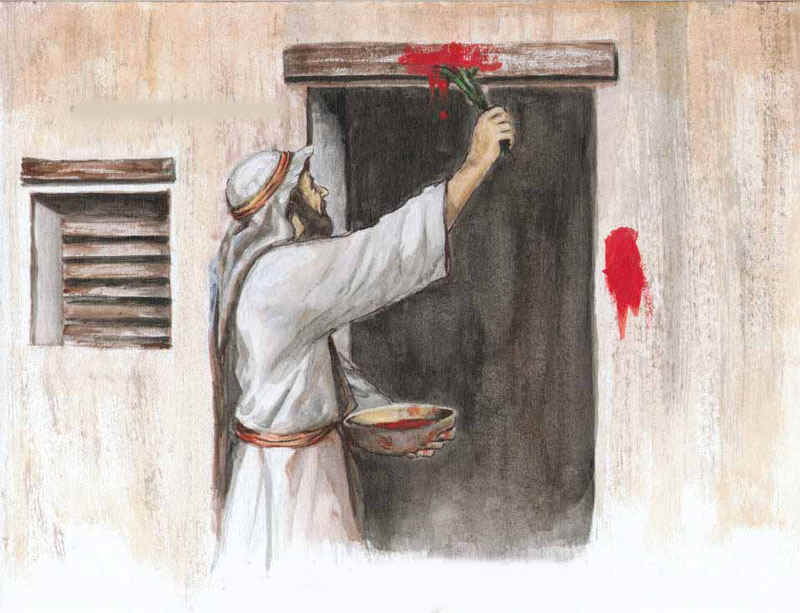
The Israelites, however, escaped this plague because the Lord had instructed them to mark the doorposts of their homes with blood from a sacrificial lamb. When the destroying angel passed through Egypt he passed over any home with blood on the doorposts, thus the name Pesakh which means Passover.

Every year Jews celebrate Pesach by preparing a meal of lamb, unleavened bread, and bitter herbs—symbols of that first miraculous Passover. The meaning of the lamb is obvious—it is about the Lamb of God, the Messiah, who would come to free us from death and the bondage of sin. Because the Israelites left in haste there was no time for bread to rise, thus the unleavened bread which is also a symbol of not being puffed up with sin. And the bitter herbs were to remind them of the long bitter years they were enslaved in Egypt.

Thus if the birth did occur during Passover, on that first Christmas night families throughout the land may have prepared and eaten their the bitter herbs, while the Son of God came into the world to offer a sacrifice that would set right all the bitter experiences of life. They may have eaten unleavened bread while the Messiah was born to save us from sin, and they may have tasted the Passover lamb, at the very moment The Lamb of God was being born.

Whether the first Christmas occured during Passover or not,the symbolism is beautiful. Because He was born, the nullifying effects of death will pass over all of us. He was born to save us, and we will live because He died.