Showing posts with label salt. Show all posts

Monday, December 10, 2012

Salted and Swaddled


During Biblical times babies were  swaddled, that doesn't mean they were simply wrapped in a blanket. Swaddling was a ritual done for all legitimate babies born to married parents and included several steps including the salting of the baby. An illegitimate baby could not be salted or swaddled.
The swaddling was done by first placing the washed baby diagonally on a swaddle cloth. The infant was then rubbed with a small amount of finely powdered salt mixed with olive oil. The cloth was then brought up and over the baby’s arms, legs, and torso. Next the end of the swaddle band, made by tying together strips of linen cloth about four or five inches wide and up to six yards long, was held under the baby’s chin, then wrapped up over the forehead and then around and around the infant all the way down to the feet keeping the limbs straight.
 
During their betrothal time women made the swaddle bands out of fine linen and embroidered them with emblems of the tribe of Israel they belonged to. After the baby was salted and swaddled the parents would pray that the child would grow to be upright and righteous and that he or she would never walk in crooked paths, but would serve God. There is some debate about the reason swaddling was done, but according to the law of Moses all sacrifices were accompanied by salt and therefore salt is a symbol of covenants. The explanation I like best for swaddling is that the baby was salted and swaddled as a reminder that the child was a covenant child born into the House of Israel.
Whatever the reason in another place in the Bible a swaddled baby is a metaphor for a legitimate child that is loved and properly cared for. Ezekiel says, when chastising Israel, “Thy birth and thy nativity is of the land of Canaan; thy father was an Amorite, and thy mother an Hittite. And as for thy nativity, in the day thou wast born thy navel was not cut, neither wast thou washed in water to supple thee: thou was not salted at all, nor swaddled at all” (Ezekiel 16:4). 
In other words, Israel is so wicked they have become illegitimate children. They have chosen to be children of the Hittites and the Amorites (children of the world) rather than be legitimate children of their God who would have swaddled and loved and cared for them.
 I love this small detail about Mary swaddling her baby because it tells us so much. First of all it gives us a glimpse into the heart of Mary who cared for her child in the best possible way. To us Jesus Christ is our Master, our Savior, our Protector, but for a time to Mary He was a dependent child. That is a relationship no one else will ever share with Him.
But there is something else. Of all people, Mary and Joseph knew the significance of this child and the circumstances concerning His conception. They knew that despite the rumors and hatemongers this child was legitimate and so by swaddling Him they proclaim to the entire world that this baby is God’s legitimate Son.
One can only imagine what Mary thought as she wrapped Him. From the moment of the miraculous conception, if not before, Mary must have sought for any information about the fate of this child. There were many prophecies, and Mary must have hung on every word the rabbis and others said about the coming Messiah. She must have asked questions and in the answers would have discovered the terrible fate that awaited her son. 
 
Therefore, as she salted the baby did she think of the fact that this child would be the sacrifice for all sin? Did seeing him wrapped tightly in the bands of birth make her think of the shroud of death that would some day cover Him? 
Whether she thought about any of these things or not, the bands Mary swaddled her Son in remind us of the day He was wrapped in burial linens and placed in a tomb. He was born to die for us, and by so doing He “swaddled” us, proclaiming us His legitimate children and providing a way to take away our “crookedness.” But most important, Jesus Christ has changed our burial linens into the swaddling bands of new birth.

Friday, November 23, 2012

I'm Thankful for Salt

Yesterday I found myself thinking about my Savior all day long. While Thanksgiving usually makes me think of the Savior, this was more. As I salted the food I was cooking it reminded me of the Atonement. As I filled salt shakers for dinner I was reminded of the covenants I had made. As I ate dinner and put more salt on my mashed potatoes, I thought about Mary salting and swaddling her baby, my Savior. Last night as the kids got hungry again and broke out the potato chips I thought about how I should be more "salted." I have so, so much to be thankful for and I need to be better at reaching out to others.

My study of salt has been amazing because of the many things I have learned, but the best part is that like yesterday I don't go through a single day without being reminded many times of the covenants and the Atonement. Studying salt has turned out to be such a blessing in my life.

Who'd have thought that going into In and Out Burger and ordering a grilled cheese would be a spiritual experience? It was on Wednesday when I pumped a little cup full of catchup and suddenly saw a container of little salt packets next to the catchup. My heart jumped at the sight and my mind suddenly filled with so many good thoughts. I love salt!

Thursday, November 15, 2012

Happy, Salty Tears


Did you ever wake up feeling so happy and blessed that you break out in tears? I've never had that happen before, but today is the day.

It is so strange because it is the thought of salt that makes me cry, and as the tears trickle over my cheeks I remember that tears are salty and cry even more because more salt make me think about Mary "salting" and swaddling her child. I see her tenderly cradling her son, and I feel her love because I've cradled a son and daughters and I know that intense feeling--it's so much a part of me that it's not just in my heart, it's in my bones and muscles and flows in my blood. It's me.

As I feel that love I think about how the child Mary cradled would grow to be a man and that the love Mary felt for Him would be so different from the hate the world would throw at Him. That hate became so intense they crucified Him, and He allowed it to happen--because of me. He sacrificed Himself for me! And then I shed more salty tears and think about how all the sacrifices under the law of Moses were salted and that the salting of His swaddling was a foreshadowing of His sacrifice.

I don't know why this research on salt has affected me so very much, but it has. Everything I see and do reminds me of salt. Besides eating it every day as I watched people throwing salt on their sidewalks and driveways during the recent storm so that the ice would melt, I remembered all the times the Savior has melted the iciness in me.

In short, dozens of times a day I encounter salt and think of my Savior so that my heart is full to overflowing. And this morning it's all spilling out.


Wednesday, November 14, 2012

Lot's Wife

Many of the symbols we find in the scriptures have duel meanings. They are good for the godly and turn into evil for the sinful. For example, water is a symbol of purification, through washings and baptism, but water can also flood and destroy the land and a people as it did in Noah's day. Fire is a symbol of the Holy Ghost and like water a symbol of purification, but fire can also destroy as it did in Sodom and Gomorrah. In many places in the New Testament leaven is a symbol of corruption and decay and the spreading of evil, but in other places it is used to mean the expansion and spreading of something good. This dualism is also true with salt. Salt is necessary to sustain life, can preserve, purify, enhance, and is permanent. But too much salt can kill, make the land infertile, or cause health problems.

This is illustrated in the story of Lot's wife. When Lot and his family were commanded to leave Sodom and Gomorrah they were told not to look back, but for some reason not explained in the scriptures Lot's wife looked back and was immediately turned into a pillar of salt. (The picture above is of a woman shaped pillar of salt that to this day locals claim is Lot's wife.)

By looking back, Lot's wife disobeyed God, she broke her covenant to obey, and a broken covenant is the opposite of purifying and enhancing. Broken covenants destroy us. The condition we inherit from either keeping or breaking covenants is eternal--it is permanent. Thus the story of Lot's wife is a warning that rebellion and disobedience can lead to permanent, eternal conditions.

Tuesday, November 13, 2012

A Covenant of Salt

Several places in the scriptures it speaks of a "covenant of salt" (For example, 2 Chronicles 13:5; Numbers 18:19). And, as I've pointed out in earlier posts, all sacrifices under the law of Moses were made with salt. This tells us that salt was very important. But what exactly is meant by a "covenant of salt?"

Among the many meanings in the symbolism of salt is the fact that salt is permanent. If you crush it you simply get finer salt. It takes a fire of over 1,400 degrees F to melt it. As a matter of fact, salt poured on a grease fire extinguishes the fire. Salt dissolved in water can be recovered by evaporating the water. Salt buried in tombs that archeologists have uncovered is thousands of years old but still good and perfectly edible. The only way to make salt useless, to make it unsavory, is to pollute it with dirt or sand.

Thus covenants made with salt are permanent and can be broken only by pollution from sin. Obviously that means that God who does not sin will never break a covenant. Only we mortals sin and break covenants. Thus a "covenant of salt" is a permanent, lasting covenant that if not broken brings great blessings into our lives.

Monday, November 12, 2012

Sustaining Life

I'm still researching salt! Who'd ever have thought there was so much to learn about salt. As I said before one of the reasons salt takes on so much symbolic meaning is because it sustains life. I could write a book about that (someone already has!), but the bottom line is that water and salt regulate all metabolic functions of the body. Without salt we would die.

The lists of all that salt does in the body is amazing, but let me just share a few of the things I've found.
               Salt stabilizes irregular heartbeats;
               extracts excess acidity from the body's cells, particularly the brain cells;
               balances the sugar levels in the blood;
               generates hydroelectric energy in your body's cells;
               increases conductivity in nerve cells for communication and information processing;
               enhances absorption of nutrients through the intestinal tract;
               clears mucous and sticky phlegm in the lungs and sinuses;
               provides body with a natural antihistamine;
               regulates sleep;
               is an anti-stress element for the body;
               helps prevent muscle cramps;
               preserves antidepressant neurotransmitters.

So when the Savior tells us to be the salt of the earth, it includes the fact that we should help sustain life in any and every way we can.

Friday, November 9, 2012

Eating Salt


Besides being a religious symbol, salt is a universal symbol of alliance and friendship. In cultures all around the world going back for centuries in time it is well attested that when one shares salt with another a bond of friendship is established that requires each to protect and come to the aid of the other in time of need. This was so recognized in many cultures that people often tricked others into eating salt with them so that an alliance would be established. Even if done through trickery, a salt alliance was upheld.
This tradition is part of the New Testament, but it has been lost in translation. For example, the book of Acts begins with Luke explaining to Theophilus that Jesus taught the people for forty days after his resurrection. Then Luke says, “And, being assembled together with them, commanded them that they should not depart from Jerusalem” (Acts1:4). In the original Greek the phrase that is translated as “being assembled together with them” is literally “to take salt in common.” This would have meant something important to Theophilus.
The apostles often “ate salt together.” The very night of Jesus’ betrayal, Judas shared salt with the Savior, and that is why in the beautiful painting of the Last Supper by Da Vinci, if you look closely, you see that Judas holds a bag, presumably the silver, in his right hand, and his left hand has just tipped over a bowl of salt—depicting the fact that Judas had broken the fellowship and the covenant of friendship. He was a traitor.

Tuesday, November 6, 2012

Salt and Leaven

I hope you're not getting tired of salt, but I'm on fire with it. I have learned so much I wish I could share it all. But bear with me while I share a few more salty thoughts.

The opposite of salt is leaven. While salt, preserves, purifies, enhances, sustains, and endures, leaven, corrupts, infects, boosts, interferes, and perishes.

The interesting thing here is how much this mimics the work of the adversary. Leaven isn't totally or all bad. Leaven has some good uses--we all love leaven in our breads. But leaven introduces destructive elements into the good. For example, it makes our bread perish faster. Likewise the adversary doesn't usually work or entice by presenting us with obvious evil. Instead he mixes truth and untruth and in very subtle ways mixes his leaven of unrighteousness into our lives so that we often overlook it and give in to it because it is so subtle.

I love what I am learning about salt especially because I see and taste and experience so often during my day that it is a constant reminder of the Atonement of Jesus Christ which preserves, purifies, enhances, sustains, and endures forever.

Monday, November 5, 2012

Salting and Swaddling

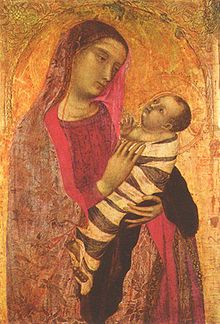
Ambrogio Lorenzetti's "Madonna and Child" (1319)
One of the things that sent me searching the subject of salt is the fact that Jesus was salted before He was swaddled. It was the custom of the day to wash, salt, and then swaddle a baby and all were part of the same procedure. In many places in the Middle East this custom is still practiced. As a matter of fact, this is so important in some Bedouin tribes that even today if there is no salt available to salt a newborn, camel urine is used because of its salt content.

No one knows for sure why babies were salted or exactly how it was done. Some say salt was mixed with olive oil and the baby rubbed with it, others say the baby was washed with salted water, still others say a small amount of salt was rubbed onto the baby's skin. Too much salt will kill an infant so only a pinch of salt would have been used. The baby was then swaddled or wrapped with a long two to three inch band of cloth from head to foot in such a way that it held the joints straight. This was a symbolic gesture suggesting that the child would be raised to be upright before the Lord and would never be crooked or wayward. The babies were not left swaddled for long, but during the short time they were swaddled the parents would meditate and give thanks for the child entrusted to their care.

The reason for the salting of infants is just as debated as the practice, but from studying the significance of salt in the Law of Moses it is obvious that salt is a symbol of an everlasting covenant and of the honesty and integrity that should accompany any covenant with the Lord. Under the Law of Moses, every sacrifical offering was offered with salt. Therefore I side with those who think that the salting of babies had something to do with dedicating this new member of the House of Israel to the Lord. Thus Jesus, like all sacrificial offerings under the Law of Moses, was salted, and knowing that his atoning sacrifice would fulfill and end the law of blood sacrifice, He instructed that the new law would be that we are to be "the salt of the earth" (Matthew 5:13 and 3 Nephi 12:13).

What this means is that we are the covenant people of the House of Israel and thus we are to enhance, protect, preserve, endure, and sustain the covenant (the Good News!) that Jesus Christ made possible.

Saturday, November 3, 2012

Just a Few Salted Words

Some of you put salt on your salad, but did you realize that the word salad is derived from the Latin word for salt which is sal?  It seems that Romans loved a dish of vegetables that were highly salted and the dish became know as salad.

You may have also heard that Roman soldiers were once paid in salt and thus we got the word salary. That isn't exactly true, but the word salary is about salt. Salt throughout history has been very valuable. Sometimes equal to gold in value. And because of its importance in sustaining life, Roman soldiers were given a daily ration of salt. But someone decided that instead of carrying large containers around so they could dispense salt to every soldier it would be easier to give them all a monetary allotment and let them buy their own salt. The money alloted became know as salary and from there we get the phrase, "He isn't worth his salt."

It is impossible to go about your day without encountering something that has to do with salt. Tomorrow you may even encounter the word salvation. If you do, think about what it has to do with salt.

Thursday, November 1, 2012

Focused on Salt

I have to apologize for missing several days here. I've been involved in some research and when I get in a project that is intriguing me like this one is I focus so intensely that time goes by and I don't even know it. It is a gift, but at the same time it is a weakness.

It is gift when I am studying and able to blank out any distraction and stay focused. It is a weakness when I am so focused that when I leave my desk to go someplace else in public my mind is still intent on the questions I am wrestling with. At those times I often pass by people I know and don't really see them. I don't acknowledge them or say hello and they must think I'm awful. I try so hard to bring myself out of what is a called a "brown study," but often I fail. Mr. J and my children have teased me about it for years. I am working on it!

But what I am studying is SALT. And I am excited about what I am learning. In the Sermon at the Temple Jesus told His followers, "Verily, verily, I say unto you, I give unto you to be the salt of the earth; but if the salt shall lose its savor wherewith shall the earth be salted? The salt shall be thenceforth good for nothing, but to be cast out and to be trodden under foot of men" (3 Nephi 12:13).

I'm sure I'll be writing more about this, but to begin . . . in the Savior's day salt was significant--so significant that at times in history it was worth ounce per ounce the same as gold. Why was it so precious? Because it was what they used to preserve their meat and fish, it enhanced the flavor of the many bland foods they ate, it purified things and was therefore used for medicinal purposes, and it was nearly indestructible. It didn't rot or decay or have a "shelf life." Everyone needs salt to stay alive and so most importantly, it sustains life. And the Savior wants us to be salt! Wow! I've been overwhelmed thinking about that.