In the last General Conference President Monson shared a story that teaches us so much about Living in Truth. He told of a cold, winter night when the temperature had dropped to 27 degrees below freezing. He and his wife had driven to their summer home in Midway to check to make sure everything was holding up in the exceptionally cold weather. The home was fine and they started back to Salt Lake City when their car stalled. Unable to get it going again, Pres. Monson and his wife began to walk back. Several cars passed them without offering to help, but finally a young man stopped to assist them.
This is where Living in Truth comes in. The simple truth was that they were stranded and had to walk in the cold. At that point they could have been attacked by Should Sharks such as, "This shouldn't be happening to me. I've sacrificed everything for God and now He let's this happen to me. He should be protecting me. He should give me a miracle and start my car." or "These people that are passing by should stop and help me." In a situation like this Should Sharks are everywhere. But President Monson didn't give in to them. How do I know? Because of what happened next.
When we give into Should Sharks and tumble ourselves into the Pit of Illusion we create so much mental static it becomes very difficult to hear the still small voice of the Spirit. But as the young man assisted them, Pres. Monson was receiving and acting upon the inspiration of the Spirit. (That's how I know he didn't pay any attention to the Should Sharks.) Pres. Monson asked the young man about a mission. He sent him a book with information about missions underlined. He followed up showing love and concern and eventually the young man accepted a call to the very mission that Pres. had once presided over.
Instead of seeing the experience of that cold, winter night as great adversity inflicted by an uncaring God, President Monson recognized it as an opportunity to serve and did as the Spirit directed.
When we Live in Truth--live with what is without being vexed by it--we open up all kinds of opportunities to serve others and bless our own lives.
Thursday, November 8, 2012
Wednesday, November 7, 2012
Missing the Morning By Mourning
A friend just stopped by to visit. Dressed in black she stepped into my foyer with a garumph and announced she was dressed in mourning because of the election. I sensed from her countenance that she was not trying to be comical and swallowed back the laugh tickling inside me. As she talked on I realized her pain was from more than just the election and was very grateful I hadn’t laughed. She was hurting, and I felt sorry for her.
But as she left I remembered the years when things like elections and daily problems and children and adversity sent me into mourning and was so grateful I’ve learned how to at least minimize the Unnecessary Pain of life even if I haven’t yet mastered escaping it all together. My heart broke for my friend because of the pain she is in, but the sadder fact is that she doesn’t need to be in pain. It is Unnecessary Pain. The sun is shining outside in the midst of a perfectly azure sky. Days don’t come more beautiful than this one, but full of black mourning my friend walked out my door totally unaware that the sun was shining on her.
Tuesday, November 6, 2012
Salt and Leaven
I hope you're not getting tired of salt, but I'm on fire with it. I have learned so much I wish I could share it all. But bear with me while I share a few more salty thoughts.
The opposite of salt is leaven. While salt, preserves, purifies, enhances, sustains, and endures, leaven, corrupts, infects, boosts, interferes, and perishes.
The interesting thing here is how much this mimics the work of the adversary. Leaven isn't totally or all bad. Leaven has some good uses--we all love leaven in our breads. But leaven introduces destructive elements into the good. For example, it makes our bread perish faster. Likewise the adversary doesn't usually work or entice by presenting us with obvious evil. Instead he mixes truth and untruth and in very subtle ways mixes his leaven of unrighteousness into our lives so that we often overlook it and give in to it because it is so subtle.
I love what I am learning about salt especially because I see and taste and experience so often during my day that it is a constant reminder of the Atonement of Jesus Christ which preserves, purifies, enhances, sustains, and endures forever.
The opposite of salt is leaven. While salt, preserves, purifies, enhances, sustains, and endures, leaven, corrupts, infects, boosts, interferes, and perishes.
The interesting thing here is how much this mimics the work of the adversary. Leaven isn't totally or all bad. Leaven has some good uses--we all love leaven in our breads. But leaven introduces destructive elements into the good. For example, it makes our bread perish faster. Likewise the adversary doesn't usually work or entice by presenting us with obvious evil. Instead he mixes truth and untruth and in very subtle ways mixes his leaven of unrighteousness into our lives so that we often overlook it and give in to it because it is so subtle.
I love what I am learning about salt especially because I see and taste and experience so often during my day that it is a constant reminder of the Atonement of Jesus Christ which preserves, purifies, enhances, sustains, and endures forever.
Monday, November 5, 2012
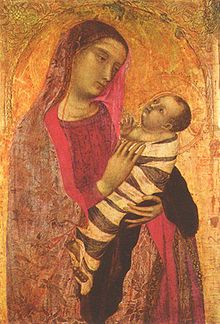
Salting and Swaddling
![]() |
| Ambrogio Lorenzetti's "Madonna and Child" (1319) |
No one knows for sure why babies were salted or exactly how it was done. Some say salt was mixed with olive oil and the baby rubbed with it, others say the baby was washed with salted water, still others say a small amount of salt was rubbed onto the baby's skin. Too much salt will kill an infant so only a pinch of salt would have been used. The baby was then swaddled or wrapped with a long two to three inch band of cloth from head to foot in such a way that it held the joints straight. This was a symbolic gesture suggesting that the child would be raised to be upright before the Lord and would never be crooked or wayward. The babies were not left swaddled for long, but during the short time they were swaddled the parents would meditate and give thanks for the child entrusted to their care.
The reason for the salting of infants is just as debated as the practice, but from studying the significance of salt in the Law of Moses it is obvious that salt is a symbol of an everlasting covenant and of the honesty and integrity that should accompany any covenant with the Lord. Under the Law of Moses, every sacrifical offering was offered with salt. Therefore I side with those who think that the salting of babies had something to do with dedicating this new member of the House of Israel to the Lord. Thus Jesus, like all sacrificial offerings under the Law of Moses, was salted, and knowing that his atoning sacrifice would fulfill and end the law of blood sacrifice, He instructed that the new law would be that we are to be "the salt of the earth" (Matthew 5:13 and 3 Nephi 12:13).
What this means is that we are the covenant people of the House of Israel and thus we are to enhance, protect, preserve, endure, and sustain the covenant (the Good News!) that Jesus Christ made possible.
Sunday, November 4, 2012
Sabbath Scripture
Salt is good:
but if the salt have lost his saltness,
wherewith will ye season it?
Have salt in yourselves,
and have peace one with another.
Mark 9:50
Saturday, November 3, 2012
Just a Few Salted Words
Some of you put salt on your salad, but did you realize that the word salad is derived from the Latin word for salt which is sal? It seems that Romans loved a dish of vegetables that were highly salted and the dish became know as salad.
You may have also heard that Roman soldiers were once paid in salt and thus we got the word salary. That isn't exactly true, but the word salary is about salt. Salt throughout history has been very valuable. Sometimes equal to gold in value. And because of its importance in sustaining life, Roman soldiers were given a daily ration of salt. But someone decided that instead of carrying large containers around so they could dispense salt to every soldier it would be easier to give them all a monetary allotment and let them buy their own salt. The money alloted became know as salary and from there we get the phrase, "He isn't worth his salt."
It is impossible to go about your day without encountering something that has to do with salt. Tomorrow you may even encounter the word salvation. If you do, think about what it has to do with salt.
You may have also heard that Roman soldiers were once paid in salt and thus we got the word salary. That isn't exactly true, but the word salary is about salt. Salt throughout history has been very valuable. Sometimes equal to gold in value. And because of its importance in sustaining life, Roman soldiers were given a daily ration of salt. But someone decided that instead of carrying large containers around so they could dispense salt to every soldier it would be easier to give them all a monetary allotment and let them buy their own salt. The money alloted became know as salary and from there we get the phrase, "He isn't worth his salt."
It is impossible to go about your day without encountering something that has to do with salt. Tomorrow you may even encounter the word salvation. If you do, think about what it has to do with salt.
Thursday, November 1, 2012
Focused on Salt
I have to apologize for missing several days here. I've been involved in some research and when I get in a project that is intriguing me like this one is I focus so intensely that time goes by and I don't even know it. It is a gift, but at the same time it is a weakness.
It is gift when I am studying and able to blank out any distraction and stay focused. It is a weakness when I am so focused that when I leave my desk to go someplace else in public my mind is still intent on the questions I am wrestling with. At those times I often pass by people I know and don't really see them. I don't acknowledge them or say hello and they must think I'm awful. I try so hard to bring myself out of what is a called a "brown study," but often I fail. Mr. J and my children have teased me about it for years. I am working on it!
But what I am studying is SALT. And I am excited about what I am learning. In the Sermon at the Temple Jesus told His followers, "Verily, verily, I say unto you, I give unto you to be the salt of the earth; but if the salt shall lose its savor wherewith shall the earth be salted? The salt shall be thenceforth good for nothing, but to be cast out and to be trodden under foot of men" (3 Nephi 12:13).
I'm sure I'll be writing more about this, but to begin . . . in the Savior's day salt was significant--so significant that at times in history it was worth ounce per ounce the same as gold. Why was it so precious? Because it was what they used to preserve their meat and fish, it enhanced the flavor of the many bland foods they ate, it purified things and was therefore used for medicinal purposes, and it was nearly indestructible. It didn't rot or decay or have a "shelf life." Everyone needs salt to stay alive and so most importantly, it sustains life. And the Savior wants us to be salt! Wow! I've been overwhelmed thinking about that.
It is gift when I am studying and able to blank out any distraction and stay focused. It is a weakness when I am so focused that when I leave my desk to go someplace else in public my mind is still intent on the questions I am wrestling with. At those times I often pass by people I know and don't really see them. I don't acknowledge them or say hello and they must think I'm awful. I try so hard to bring myself out of what is a called a "brown study," but often I fail. Mr. J and my children have teased me about it for years. I am working on it!
But what I am studying is SALT. And I am excited about what I am learning. In the Sermon at the Temple Jesus told His followers, "Verily, verily, I say unto you, I give unto you to be the salt of the earth; but if the salt shall lose its savor wherewith shall the earth be salted? The salt shall be thenceforth good for nothing, but to be cast out and to be trodden under foot of men" (3 Nephi 12:13).
I'm sure I'll be writing more about this, but to begin . . . in the Savior's day salt was significant--so significant that at times in history it was worth ounce per ounce the same as gold. Why was it so precious? Because it was what they used to preserve their meat and fish, it enhanced the flavor of the many bland foods they ate, it purified things and was therefore used for medicinal purposes, and it was nearly indestructible. It didn't rot or decay or have a "shelf life." Everyone needs salt to stay alive and so most importantly, it sustains life. And the Savior wants us to be salt! Wow! I've been overwhelmed thinking about that.
Subscribe to:
Posts (Atom)